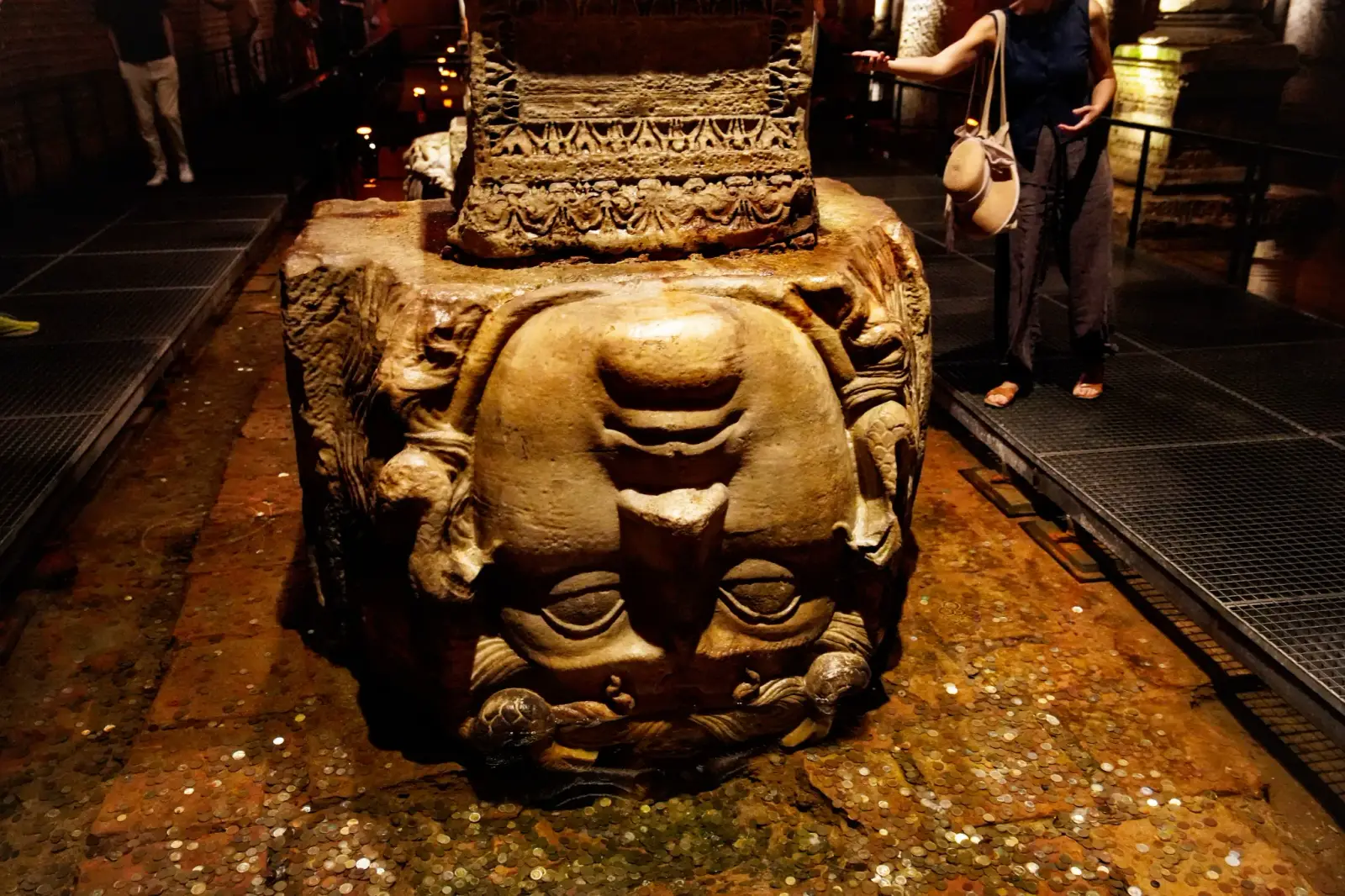
The Medusa heads: history, myth and meaning
Two reused Roman blocks, one upside down and one on its side. What is documented, what is myth, and the four explanations offered for the way they were set.
History · Last reviewed 30 August 2026
In the north-western corner of the Basilica Cistern stand two of Istanbul’s most photographed and most puzzling sculptures: a pair of large stone Medusa heads used as column bases. One is upside down; the other lies on its side. They are not original to the sixth-century cistern. They are spolia — reused architectural elements taken from an earlier Roman building and built into Justinian’s reservoir.
What can be said with confidence
The cistern was built around 532 under Justinian I, largely from recycled material, after the Nika Riots. Byzantine builders regularly reused good stone from older Roman structures, and the two Medusa heads belong to that practice. Scholars generally date them to the late Roman period, roughly the fourth century or earlier. Their original location is not known, though similar heads have been found in the area of the Forum of Constantine, and one related example is now in the Istanbul Archaeological Museums.
The heads lay for a long time under thick silt and mud. They became widely known only during the cleaning and restoration of 1985–1987, when more than fifty thousand tonnes of debris were removed and the elevated walkways were installed. Since then they have been the cistern’s defining feature.
There is no contemporary Byzantine text explaining why these particular blocks were chosen or why they were set in such unusual positions. Every modern interpretation is a reconstruction built from archaeology, mythology and what is known of the period’s habits.
The myth
In Greek mythology Medusa was one of the three Gorgon sisters. The version that became famous — popularised by later Roman writers, Ovid among them — describes her as a beautiful woman transformed by the goddess Athena: after Poseidon assaulted her in Athena’s temple, Athena cursed her, her hair became living snakes, and anyone who met her gaze turned to stone.
The hero Perseus was sent to kill her. Using a polished shield as a mirror so that he would not have to look at her directly, he beheaded her while she slept. Even severed, the head kept its power. Perseus gave it to Athena, who set it on her aegis as an apotropaic emblem — an image that turns danger away.
Because of that power, the Gorgon’s face was used widely in the ancient world as a protective device: on armour, on temples, over doorways, in floors, wherever evil was to be warded off.
Why upside down and sideways?
Practical and architectural reasons are what most archaeologists accept. The blocks were simply the right size and shape to make sturdy column bases. One fitted better inverted; the other worked better on its side. On a construction project reusing hundreds of columns and capitals, structural need came before symbolism.
Neutralising the gaze is the popular and enduring belief: that the heads were deliberately inverted or tilted so that Medusa could not look directly at people, or at the water. Turning the face away from upright neutralises her.
Christian symbolism is a third reading. In an early Byzantine Christian context, reusing and defacing pagan imagery could be a statement in itself — placing a powerful pagan symbol upside down as a demonstration that the old gods had been overturned.
Apotropaic protection is a fourth. Some scholars suggest the heads were placed here precisely because of their traditional protective association: submerged at the base of columns in a vital reservoir, they may have been meant to guard the water against harm.
Most serious historians lean toward a combination of practical reuse and residual cultural attitudes to pagan images. The dramatic orientations, though, have kept the more mythical readings alive.
What they mean now
- Historically, they are tangible evidence of how Byzantium recycled the material remains of the classical world.
- Mythically, they keep an ancient story of beauty, violation, curse and power present inside a Christian-era structure.
- Atmospherically, in the dim watery light the faces look almost alive, and the angles sharpen the unease most visitors feel.
- Culturally, they have become the defining image of the Basilica Cistern, on countless photographs, postcards and souvenirs.
They are, in short, both ordinary construction material and extraordinary mythic presence — a reminder that the cistern is not only a piece of Byzantine engineering but a place where the classical past was literally built into the foundations of a new Christian imperial city: sometimes upright, sometimes inverted, never entirely erased.
Ready to go down?
Choose your date — your ticket is handed over at a meeting point beside the cistern.
Book tickets