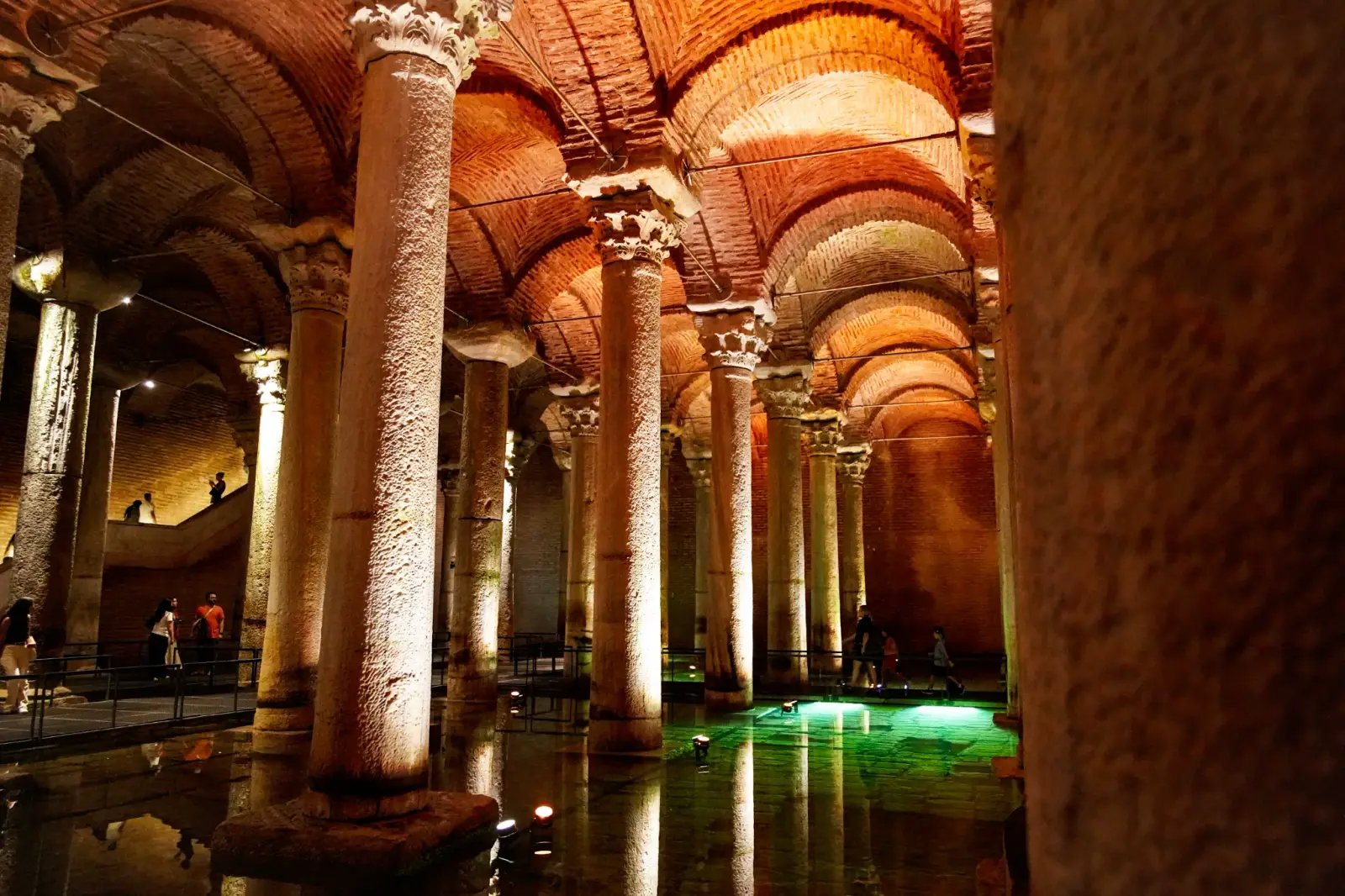
The 336 columns: origins and architecture
Spolia, the Weeping Column, the brick vaulting and the half-finished capitals — the traces of a reservoir built quickly out of whatever the city had to hand.
Architecture · Last reviewed 30 August 2026
The Basilica Cistern is defined by its forest of 336 marble columns. They are not merely structural supports; they are the building’s most striking visual and technical feature, and one of the clearest examples anywhere of how Byzantine Constantinople reused the classical past.
The cistern was built in the sixth century under Justinian I, around 532, largely in the aftermath of the Nika Riots. It sits beneath the courtyard of the Stoa Basilica on the First Hill, and it was built to store water for the Great Palace and the imperial buildings around it.
Spolia
Because the structure was utilitarian and underground, its builders felt free to use whatever was to hand. The majority of the columns are spolia — architectural elements taken from earlier Roman buildings across the empire and reused. The practice was ordinary in Late Antiquity and early Byzantium: high-quality marble shafts and capitals from disused temples, forums and public monuments were cheaper and faster to obtain than freshly quarried stone. Only a minority, traditionally cited as around 98 columns, appear to have been cut new for the cistern.
The Medusa bases
In the north-western corner, two columns rest on large stone blocks carved with the face of Medusa — one upside down, the other on its side. These are late Roman sculptures, almost certainly removed from an earlier building and reused as convenient bases.
Their orientations have invited several readings. The most popular is that the builders inverted or tilted them deliberately, to neutralise the Gorgon’s power to turn the living to stone. Another sees a quiet Christian statement, the new faith over pagan imagery. A third and more prosaic explanation is structural: the blocks simply fitted better that way. Whatever the intention, they remain the cistern’s most powerful symbolic feature, and the point where classical mythology meets Byzantine pragmatism.
The Weeping Column
One column stands out for its surface: raised teardrop shapes, eye-like figures and branching patterns. It is known as the Weeping Column, the Column of Tears or the Hen’s Eye Column, and it is perpetually damp — a function of the humidity and of the marble itself.
The carving closely resembles decorative elements from the fourth-century Triumphal Arch of Theodosius in the Forum Tauri, modern Beyazıt Square, and scholars therefore identify it as another piece of spolia. Popular legend says instead that the tears commemorate the enslaved labourers who died during construction. The memorial story is folklore rather than documented history, but the sight of moisture running down the carved surface keeps it alive. A modern visitor tradition of putting a thumb into a small recess and making a wish has added another layer to the same stone.
Details worth looking for
- Varied bases and plinths: some columns stand on simple blocks, others on more elaborate or mismatched pedestals — again, whatever was available.
- The brick vaulting: light brick cross-vaults set in thick mortar, a method that allowed large spans while keeping the structure relatively light. It is an engineering achievement that influenced later Byzantine building.
- Waterproofing: the thick brick walls were coated with a hydraulic mortar that has kept the chamber watertight for close to fifteen centuries. The corners of the reservoir were often rounded or bevelled to resist water pressure better.
- Unfinished capitals: a number of the Corinthian capitals are only partly carved. They may have been unfinished pieces taken from a workshop or from storage, and they offer a rare glimpse of how Late Antique sculpture was actually produced.
- Traces of earlier use: on some shafts you can still make out differences in weathering or tool marks that hint at another building, somewhere else.
What the details add up to
Taken together they tell a coherent story. The Basilica Cistern was never designed as a showpiece; it was a functional reservoir built quickly after the Nika Riots. Its builders worked with what was at hand — high-quality classical stone, mixed styles, practical engineering — and in the process made one of the most atmospheric interiors in the Byzantine world, more or less by accident.
The inverted Medusa faces, the teardrop carvings and the mismatched capitals are not secret codes left for modern visitors to decode. They are the visible traces of a pragmatic construction process in which the classical past was dismantled, carried across a city and reassembled to serve a new Christian empire. What feels mysterious today was, in the sixth century, simply efficient reuse.
Standing among the columns, you see both the engineering intelligence of Justinian’s Constantinople and the quiet persistence of older forms and older myths. The Medusa heads still watch, the Weeping Column still appears to cry, and the forest of spolia still holds up the roof.
Ready to go down?
Choose your date — your ticket is handed over at a meeting point beside the cistern.
Book tickets