The complete history of the Basilica Cistern
From the Stoa Basilica and the Nika Riots through the Ottoman centuries and Gyllius’ rediscovery to the 2022 reopening and the 2026 change of hands.
History · Last reviewed 30 August 2026
The site and the construction
The Basilica Cistern stands on the First Hill of Constantinople — modern Sultanahmet — about 150 metres south-west of Hagia Sophia. Before the cistern existed, a large public complex known as the Stoa Basilica occupied the site: a Roman-era basilica of the third or fourth century that served as a commercial, legal and cultural centre, with porticoes, gardens, a library and rooms for legal proceedings. The structure burned in 476, was rebuilt, and was heavily damaged again during the Nika Riots of 532.
In the aftermath of those riots, Emperor Justinian I — who reigned from 527 to 565 — ordered a vast underground cistern beneath the rebuilt complex. Work began around 526–532. Contemporary sources claim some 7,000 enslaved people were involved in the labour. The cistern was designed both to store surplus water from the aqueduct system in the wetter months and to supply the Great Palace and the imperial buildings around it through dry summers and through sieges.
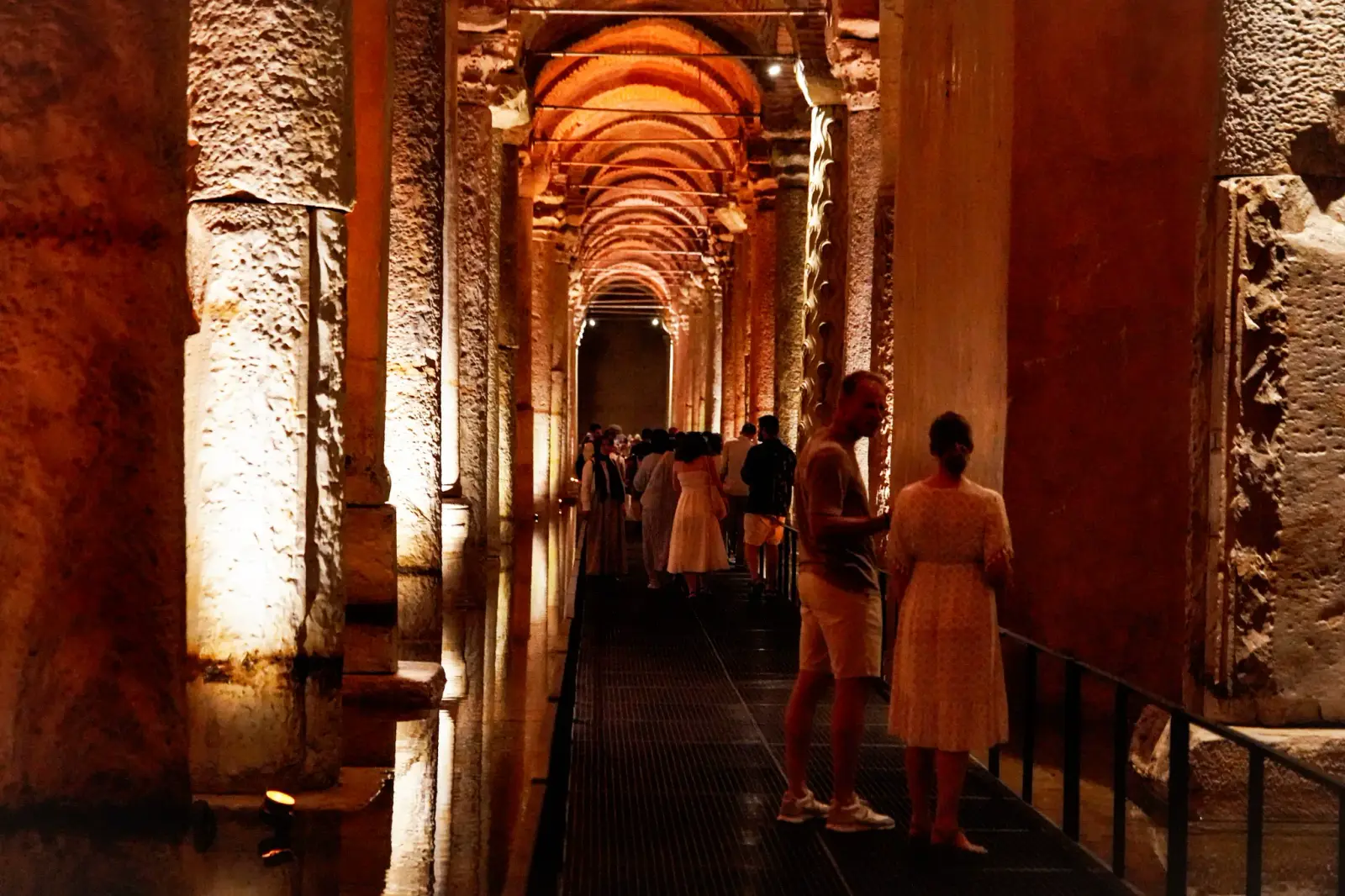
Water reached the cistern from the Belgrade Forest, about 19 kilometres north of the city, by way of the Valens (Bozdoğan) Aqueduct. At capacity it could hold roughly 80,000 to 100,000 cubic metres. The chamber measures approximately 140 by 70 metres and is carried by 336 marble and granite columns, each about nine metres high, in twelve rows of twenty-eight. Many of the columns and capitals were reused from earlier Roman buildings, and so were the two Medusa heads that serve as column bases.
Use through the centuries
Through the Byzantine period the cistern was a critical part of the city’s water network, supplying the Great Palace and the elite residences nearby. Covered cisterns like this one were what allowed Constantinople to survive a siege, when the aqueducts outside the walls could simply be cut.
By the later Byzantine centuries it appears to have fallen into partial disuse, or at least out of the central authorities’ view. After the Ottoman conquest in 1453 it continued for a time to supply water to the gardens of the new Topkapı Palace, but the Ottomans preferred flowing spring water delivered through their own fountains and aqueducts, and once those systems were in place the old cistern gradually lost its function.
Rediscovery
In the mid-sixteenth century the French scholar and traveller Petrus Gyllius — Pierre Gilles — came upon the cistern while researching the Byzantine remains of the city. He recorded being rowed between the columns and seeing fish in the water. Local residents were still drawing water from it through wells above; what had been forgotten was the scale of the thing, and only by outsiders.
It was repaired twice under Ottoman rule: in the early eighteenth century under Sultan Ahmed III, by the architect Kayserili Mehmet Ağa, and again in the late nineteenth century under Sultan Abdülhamid II. It was never returned to full water storage, and it slowly filled with mud and debris.
Restoration and the museum
The major modern restoration ran from 1985 to 1987, under the Istanbul Metropolitan Municipality. Tens of thousands of tonnes of mud were removed, walkways were installed, and the site opened to the public as a museum in 1987. The two Medusa heads became widely known in this period.
A second comprehensive restoration, with seismic strengthening, ran from roughly 2017 to 2022. The cistern reopened in July 2022 with new visitor infrastructure, new lighting and new conservation measures. For several years afterwards it was run by the municipality’s cultural company, Kültür A.Ş., and became one of the city’s most popular paid attractions, with timed entry, audio guides and the occasional evening Night Shift programme of special lighting and sometimes music.
Where things stand
In 2026 the cistern became the subject of a legal and administrative dispute. The ownership records were transferred to the General Directorate of Foundations — Vakıflar Genel Müdürlüğü, an agency under the Ministry of Culture and Tourism — on the grounds that the site falls under historic vakıf, or endowment, property law. The Istanbul Metropolitan Municipality challenged the transfer in court. There were temporary closures and evacuations in early June 2026 during the handover, followed by conflicting court rulings and a period of legal uncertainty.
As of the most recent information, the site has reopened under the new administrative framework, though the operational details — ticketing, pricing, Night Shift availability and the long-term management arrangement — have continued to move. Check the official site or the notice at the door for the current hours, prices and restrictions.
Today the cistern is kept with only a shallow layer of water, so that visitors can walk through it on raised platforms. It functions purely as a cultural site rather than a working reservoir. Its 336 columns, its Medusa heads and the play of light on water still make it one of the most distinctive surviving monuments of Byzantine Constantinople: a building that began as a practical answer to an imperial capital’s water problem, survived centuries of neglect and changing regimes, and has become one of Istanbul’s signature experiences.
Ready to go down?
Choose your date — your ticket is handed over at a meeting point beside the cistern.
Book tickets